

Arizona wine country isn’t one valley or a single tasting route. It spans three federally recognized American Viticultural Areas: Verde Valley, Willcox, and Sonoita. From Phoenix, Verde Valley is about two hours north by car, making Northern Arizona wine country a scenic day-trip option.
If you picture Arizona mainly as sunbaked desert, its vineyards may come as a surprise. Elevation, terrain, and climate give each wine region its own character, shaping the grapes grown there and the wines made from them.
Learn where the regions are, what distinguishes their vineyards and grapes, and how Arizona winemaking began. Then plan a Verde Valley tasting experience from Phoenix, using Sedona or Cottonwood as a base to explore the high-desert scenery and local pours.
Key Takeaways
- Arizona’s three federally recognized wine regions are Verde Valley, Willcox, and Sonoita, each shaped by its own high-desert setting.
- AVA labeling has a specific standard: according to the Alcohol and Tobacco Tax and Trade Bureau, at least 85% of the grapes must come from the named AVA.
- Explore how elevation and local growing conditions influence Arizona’s grape varieties and the wines made from them.
- Trace the state’s winemaking story from its early roots through the milestones that helped revive the industry.
- For a Northern Arizona tasting outing, consider The SIP Tour and discover Verde Valley pours amid Sedona’s red-rock scenery.
WHERE IS ARIZONA WINE COUNTRY?
Arizona wine country spans distinct high-desert regions. In Northern Arizona, Verde Valley offers a tasting route, with Cottonwood, near Sedona, serving as a practical anchor for winery visits.
For a Verde Valley stay, consider basing yourself in Cottonwood or Sedona, and include FnB restaurant in your dining plans. From either town, you can shape a visit around winery stops and the surrounding landscape.
Verde Valley Wineries and Tasting Rooms
Verde Valley’s wineries and tasting rooms are set among Northern Arizona’s high-desert scenery. Cottonwood is a useful hub for planning tasting stops, while nearby Sedona adds red-rock views to the trip.
The Verde Valley region has 25 tasting rooms, and Cottonwood’s Main Street has more than 10 places to taste wine. Cottonwood sits between Arizona’s desert and high country, with the Verde River running nearby. Its name comes from the cottonwood trees along that river, and surrounding mountains, mesas, and buttes shape the setting. Allow time for tasting and travel between stops rather than treating every venue as one walkable route.
Before visiting Verde Valley wineries, check their operating hours and make reservations when required. This helps you build a realistic route and avoid arriving when a tasting room is closed or full. FnB restaurant is another option to consider as you plan your Arizona itinerary.
Sonoita and Elgin Winery Tours
Sonoita and Elgin make up a Southern Arizona wine destination, where visitors can pair vineyard scenery with winery stops across the countryside. Their location makes them a separate outing from Northern Arizona.
Sonoita and Elgin are 50 miles south of Tucson, and Sonoita is about an hour southwest of Willcox. Elgin is home to Los Milics Winery, whose vineyard covers 20 acres. Elgin Winery and Distillery is another named stop for visitors planning a tasting outing. Because the route spans rural communities, organize stops around the places you want to visit, and allow time for the drive between them.
For a winery tour, group Sonoita and Elgin stops into a Southern Arizona itinerary rather than combining them casually with Verde Valley in one outing. Los Milics Winery gives visitors an Elgin vineyard stop, while Elgin Winery and Distillery adds another destination to consider. If your trip centers on Phoenix, the Verde Valley is about 100 miles north along SR-260 and SR-89A near Sedona, making it a distinct Northern Arizona route.
Arizona wine regions and AVAs
Arizona’s wine regions span high-desert valleys, mountain foothills, and open vineyard country. Differences in elevation and climate help explain why tasting in Verde Valley can feel distinct from visiting Willcox or Sonoita.
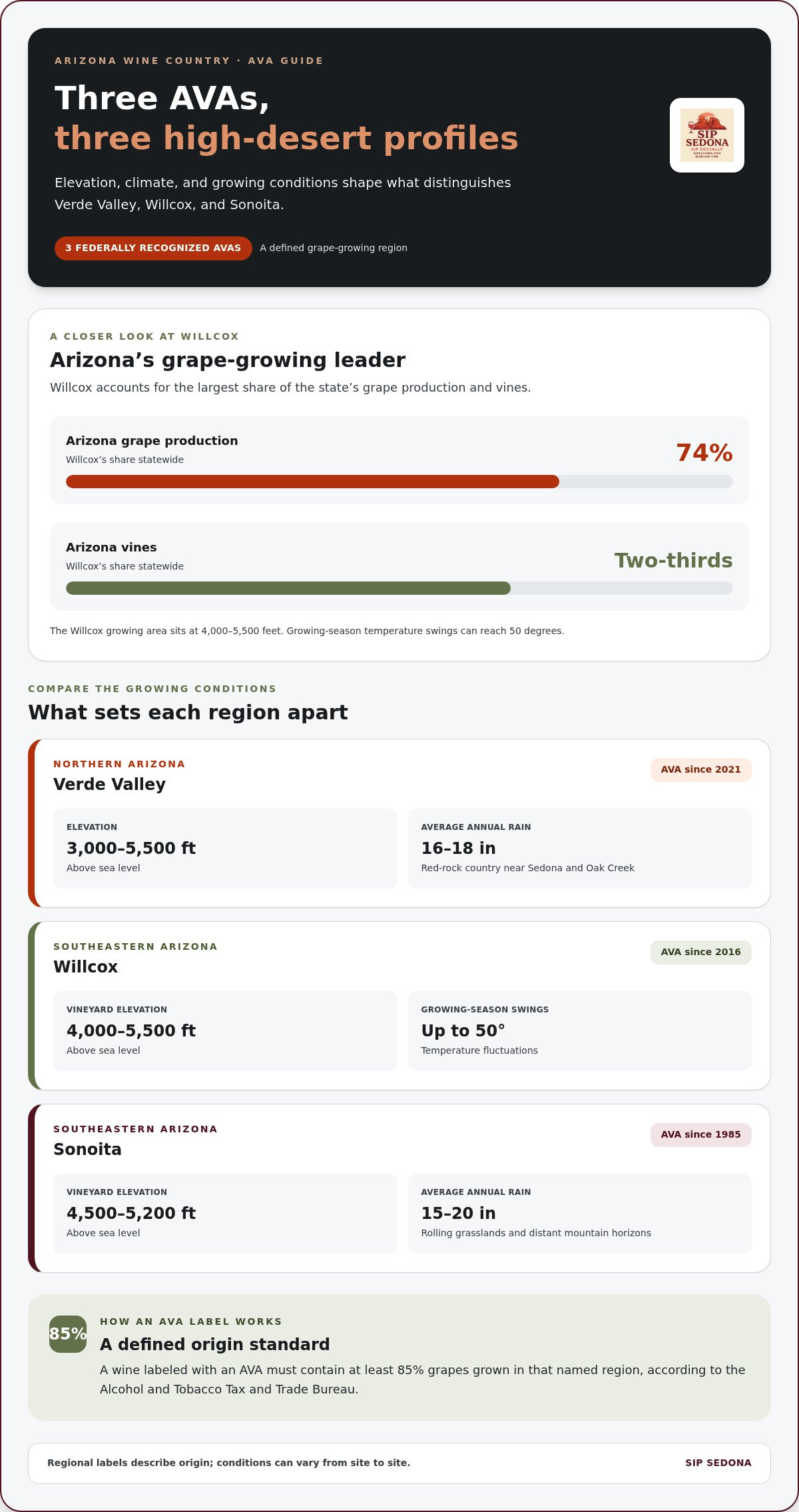
Arizona has three federally recognized American Viticultural Areas: Verde Valley, Willcox, and Sonoita. An AVA identifies a defined grape-growing region, giving wine drinkers useful context about where grapes originate. According to the Alcohol and Tobacco Tax and Trade Bureau, a wine labeled with an AVA must contain at least 85% grapes grown in that AVA.
The designations also have different histories. Sonoita became an AVA in 1985, Willcox in 2016, and Verde Valley in 2021. These dates show how Arizona’s recognized wine map has developed over time, adding a Northern Arizona region alongside southeastern growing areas.
Each place offers a different landscape to take in between pours. Verde Valley vineyards sit roughly 3,000 to 5,500 feet above sea level, amid red-rock country near Sedona and Oak Creek. The surrounding valley, mesas, and mountain views make the drive part of the experience. Sonoita’s vineyards occupy elevations of 4,500 to 5,200 feet, with rolling grasslands and distant mountain horizons.
Climate adds another point of contrast. Verde Valley receives an average of 16 to 18 inches of rain per year, while Sonoita averages 15 to 20 inches. In the Willcox area, vineyards grow between 4,000 and 5,500 feet, and growing-season temperature swings can reach 50 degrees. Those shifts between warm days and cooler nights shape the conditions growers work with. Soil and site conditions also vary within each region, so a regional label describes an area, not an identical vineyard environment.
Wine regions near Sierra Vista offer another way to explore southeastern Arizona. The area has 24 tasting rooms, giving visitors a range of places to sample local wines. Willcox itself is about an hour east of Tucson, while Sonoita sits south of Tucson, making these regions distinct excursions from the Verde Valley.
When planning around weather, roads, and safety, account for elevation and your route. High-desert temperatures and driving conditions can vary between valleys and mountain roads. Travel in daylight when practical, adjust your driving to road conditions, and leave time between tasting stops.
Want to focus your visit on the north? Explore Northern Arizona wine tours around Sedona and Verde Valley.
Arizona grape varieties
Arizona growers work with a range of wine grapes, and each region’s growing conditions shape what vineyards can produce. Willcox is the state’s largest grape-growing area, accounting for 74% of Arizona’s grape production and two-thirds of its vines. That concentration makes southeastern Arizona a useful place to explore the grapes behind locally made wines.
Willcox’s vineyard landscape helps explain why its role matters. The growing area sits east of Tucson, with vineyards planted at elevations between 4,000 and 5,500 feet. During the growing season, temperature fluctuations can reach 50 degrees. These conditions influence how grapes develop, so tasting wines from Willcox offers a chance to notice how local fruit expresses the character of its growing region.
Arizona wineries also grow grapes beyond Willcox. In Elgin, Los Milics Vineyards grows 17 different types, offering a broad example of varietal diversity within one vineyard. On its Sonoita property, Rune Wines has three acres planted with Grenache, Viognier, and Syrah. Those names provide a starting point for comparing the grapes used in Arizona wines, rather than assuming every bottle reflects one dominant style.
Try tasting the varieties side by side when a winery offers them. Notice the differences in aroma, body, and finish, then compare a single-variety wine with a blend. Deep Sky Vineyard’s 2021 Comet blend combines Grenache, Syrah, and Mourvedre. It offers a concrete example of how Arizona producers bring multiple grapes together in one wine.
Grape growing in Arizona has a long history. Wine grape cultivation has been documented for 400 years, beginning with Spanish Missions. Spanish missionaries planted grapes for sacramental wine in the late 1700s. That history links Arizona vineyards to early religious communities, while today’s growers choose and plant varieties suited to their own sites.
For visitors, the regions matter as much as the grape names. Willcox’s role in Arizona grape production makes it a useful reference for understanding local fruit, while Elgin and Sonoita show the range of grapes grown at individual vineyards. Compare wine labels and tasting notes by grape and region. This helps distinguish a varietal wine from a blend and connect each pour with its Arizona growing area.
As you taste, look for Grenache, Syrah, and Viognier on vineyard or winery tasting lists, then ask how the producer uses each grape. Compare a single-variety pour with Deep Sky’s Comet blend to see how blending changes the final profile. With 17 grape types at Los Milics Vineyards, Elgin offers another lens on the breadth of Arizona’s plantings.
History of Arizona winemaking
Arizona’s wine story stretches back centuries, followed by periods of expansion, interruption, and revival. These milestones explain how today’s tasting rooms and wineries reflect both a long regional tradition and a modern craft scene.
In 1703, Jesuit missionary and explorer Eusebio Francisco Kino reported growing grapes and making wine for Mass at Mission Dolores in nearby Sonora. Spanish missionaries later planted grapes for sacramental wine in Arizona in the late 1700s. These early roots connect wine growing with mission communities, long before commercial vineyards became part of the desert economy.
By the mid-1870s, farmers in the Salt River Valley around Phoenix had begun making wine. A small winemaking industry emerged in Mesa during the 1880s, and Arizona’s first commercial winery opened in the early 1880s. These beginnings followed settlement and growing local demand. They also predate the modern commercial era, which began much later.
Arizona established its state wine appellation in 1912, but the industry soon faced a sharp interruption. The state enacted Prohibition in 1914, five years before the federal Volstead Act. National Prohibition began in 1920, and making wine in Arizona remained illegal from 1914 until legislation legalized it again in 1982. That long gap divided early production from the growers and winemakers who rebuilt the industry.
Research helped make that revival possible. A 1970 study examined the feasibility of Arizona wine-growing regions, while Dr. Gordon Dutt’s experiments beginning in the mid-1970s showed that parts of Arizona could produce quality wine grapes. Arizona’s first modern commercial winery opened in 1979. Navy veteran Robert Webb opened R. W. Webb Winery in Tucson in 1980, and the Arizona Wine Growers Association formed two years after the first modern winery opened.
Legislation and individual producers then helped establish a lasting modern scene. Arizona legalized wine production again in 1982 and passed the Farm Winery Bill in 1984. Callaghan Vineyards has produced wine since 1990, while Dos Cabezas WineWorks began near Willcox in 1995. Todd and Kelly Bostock took over Dos Cabezas in 2006, adding another chapter to the state’s evolving producer history.
These dates add context to a tasting-room visit. A bottle from Willcox or a pour near Sedona reflects a modern industry shaped by earlier mission-era growing, interrupted production, and renewed experimentation. Arizona’s wine history isn’t a straight line: growers have adapted to the desert and found new ways to make local wines.
Northern Arizona wine country tours from Phoenix
Yes, visitors can build an itinerary around Verde Valley tasting rooms near Sedona, with Cottonwood as another regional stop. The Verde Valley is about 100 miles north of Phoenix along SR-260 and SR-89A, near Sedona.
For a Phoenix outing, plan around the drive, tasting stops, and time to enjoy the scenery. Verde Valley is about two hours north by car, and a Phoenix-to-Northern-Arizona wine-country tour is listed as a nine-hour outing. That gives you a sense of the time commitment, while recognizing that stops vary in distance and duration.
Think of Verde Valley as a regional itinerary, not one tasting-room address. Cottonwood has a cluster of tasting rooms on Main Street, while Sedona offers red-rock views and access to nearby Oak Creek. Choose a base or focal town first, then plan tasting stops around it so driving doesn’t take over the day.
Arizona’s geography is a good reason to focus a Phoenix visit on one wine region at a time. Willcox and Sonoita are in the south, while Verde Valley is the Northern Arizona option. The distances and landscapes make these separate outings, rather than destinations to combine in one tasting day.
Build a practical itinerary by choosing the places you want to visit, then allowing for travel between them. Check Verde Valley wineries’ operating hours and reserve ahead when needed. A tasting room’s schedule can determine which stops fit comfortably into the day. Leave time for a meal and an unhurried tasting instead of packing in too many appointments.
A map is most useful when it shows the towns and roads connecting the stops, not just winery names. Mark Phoenix, Sedona, and Cottonwood first, then place each tasting room on the route. SR-260 and SR-89A provide the regional connection described for Verde Valley, while local roads link individual destinations. The result is a clear plan for a beautiful drive through Northern Arizona’s viticultural landscape.
For a relaxed Phoenix-to-Verde Valley tasting day, plan your Northern Arizona wine outing around the region’s wineries and scenery.
SIP Sedona: The SIP Tour
SIP Sedona makes it easier to plan transportation around Verde Valley wineries and scenery. Choose the Private SIP Tour for a private outing, or the Custom Group Shuttle for transportation between your planned stops. Wedding & Event Transportation supports travel for celebrations in the area.
These options suit visitors who would rather enjoy the company and views than coordinate every ride. Choose your winery stops first, then select transportation that fits your plans and occasion.
Planning an Arizona wine-country outing? Contact SIP Sedona to choose the transportation option that fits your plans.
Make Your Next Arizona Wine Country Visit Your Own
Shape your next tasting day around what you most want to enjoy: a relaxed pace, good company, and time to take in the high-desert scenery. Instead of trying to visit every destination, choose an experience that suits your plans and leave room to discover a favorite pour.
For an outing in Verde Valley, The SIP Tour offers a social way to experience local wine tasting. For a private outing, choose the Private SIP Tour. A Custom Group Shuttle can provide transportation for your group.
Ready to start planning? Contact SIP Sedona about your visit and take the first step toward a relaxed day among Arizona’s vineyards and red rocks. The best memories often come from slowing down and enjoying the moment.
Frequently Asked Questions
What are the main wine regions in Arizona?
Arizona’s three federally recognized wine regions are Verde Valley, Willcox, and Sonoita. For Northern Arizona, focus on Verde Valley and the tasting areas around Cottonwood and Sedona. Willcox and Sonoita are southeastern destinations, better suited to a separate trip based around Tucson or the surrounding countryside. Choosing one region as your base means spending more of the day tasting and less time crossing the state.
Where are Arizona's wineries and vineyards located?
Arizona wineries and vineyards are concentrated in Verde Valley, Willcox, and Sonoita, with additional tasting rooms near Sierra Vista. Verde Valley is near Sedona and Cottonwood; Willcox is east of Tucson, while Sonoita and Elgin are south of Tucson. When planning, search by town as well as winery name. Tasting rooms can be spread along rural roads, so nearby stops often make a more practical outing.
What are the best wineries to visit in Arizona wine country?
The “best” Arizona winery depends on whether you want vineyard scenery, a town tasting room, or a particular grape variety. Los Milics Vineyards in Elgin is a useful choice for exploring a vineyard setting and varied plantings. In Northern Arizona, Cottonwood offers a cluster of tasting options, while Sedona adds red-rock scenery. Choose stops that match your interests, then confirm hours and reservations before setting your route.
What is the difference between Verde Valley, Sonoita, and Willcox wine regions?
Verde Valley is Arizona’s Northern Arizona wine region, close to Sedona’s red-rock landscape and Cottonwood’s tasting rooms. Sonoita and Willcox lie in the southeast: Sonoita and Elgin offer rural vineyard scenery, while Willcox is a major grape-growing area. Their settings and growing conditions shape what visitors see and taste. For a short trip from Phoenix, focus on Verde Valley; the southern regions suit a separate itinerary.
What Arizona wines and grape varieties are most popular?
Arizona vineyards grow varieties including Grenache, Syrah, Viognier, and Mourvedre, but no single grape defines every region or producer. Willcox accounts for a large share of the state’s grape production, while Los Milics Vineyards in Elgin grows 17 different types. For a tasting, compare a single-variety pour with a blend such as Deep Sky Vineyard’s Comet, which combines Grenache, Syrah, and Mourvedre.
How much do Arizona wine tastings and winery tours cost?
Tasting fees and food costs are set by individual venues, so include them separately in your budget. An 18% gratuity is automatically added to all tours. Wine tastings and food aren’t included in those tour prices, so guests pay for what they choose at stops.
What are the rules for wine tasting, reservations, and transportation in Arizona?
For SIP Sedona tours, guests must be 21 or older to taste wine and show ID at each venue; under-21 guests need a parent or guardian and aren’t served alcohol. Alcohol isn’t permitted inside SIP Sedona vehicles. Winery hours and reservation needs vary, so call venues before visiting. Plan transportation before tasting, and don’t rely on driving yourself between stops after drinking.


