

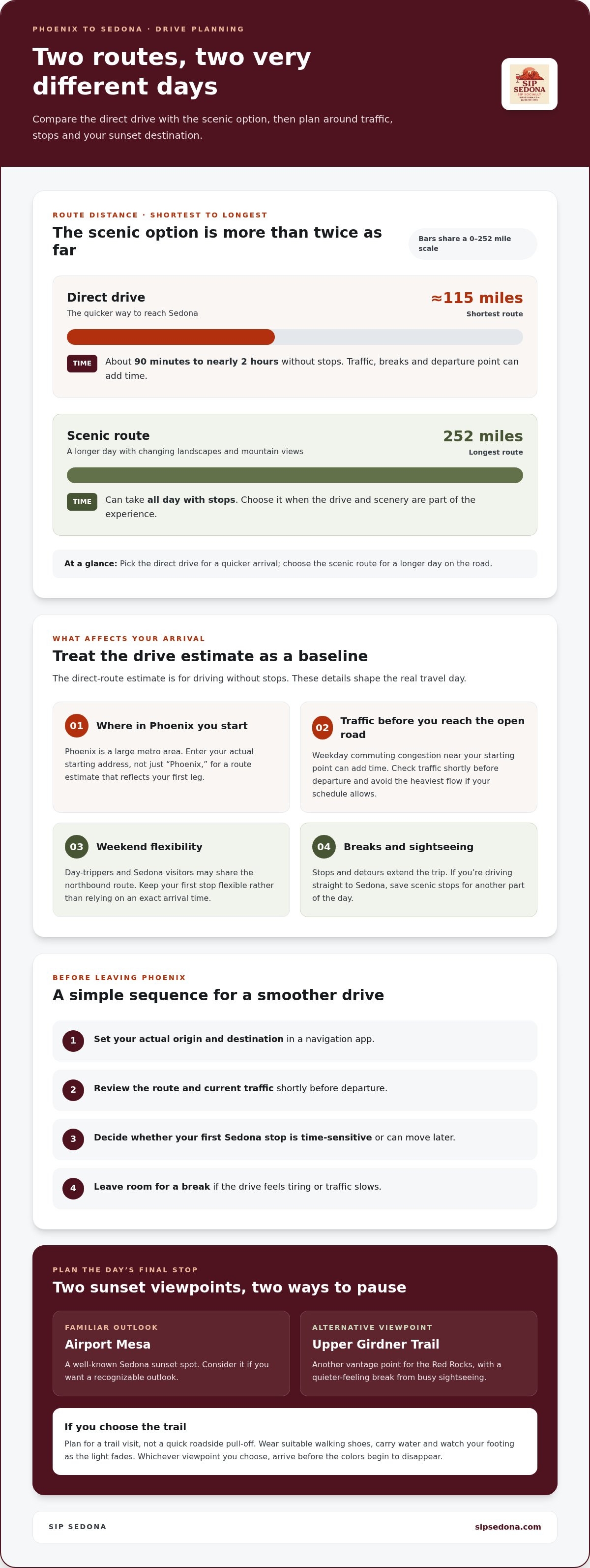
The quickest Phoenix-to-Sedona drive is about 115 miles and takes roughly 90 minutes to nearly two hours without stops. These insider tips for visiting Sedona from Phoenix will help you choose between the direct drive and a longer scenic route, then time your arrival for sunset over the Red Rocks.
The direct route gets you to Sedona sooner, but the drive can be part of the day’s appeal. If you’re willing to spend more time on the road for changing desert landscapes and mountain views, a scenic detour may be worth adding to your plans.
Here’s what to know before you set out: how long each drive takes, when to leave Phoenix, which route offers the most memorable scenery, and where to find an alternative sunset viewpoint. A little planning leaves more room to slow down, soak in the high-desert colors, and savor Sedona at an easy pace.
Key Takeaways
- The direct Phoenix-to-Sedona drive is about 115 miles; traffic, stops, and your departure time all shape the day’s travel.
- Plan your departure around Phoenix traffic and leave room for slower stretches on the way north.
- For a longer day of changing landscapes, the scenic route covers 252 miles and can take all day with stops.
- Look beyond Airport Mesa for sunset: the upper section of Girdner Trail offers another viewpoint.
- Choose the direct drive for a quicker arrival, or make the scenic route part of the Sedona experience.
1. Alternative sunset viewpoints
Airport Mesa is a familiar Sedona sunset spot, while the upper section of Girdner Trail offers another place to watch the Red Rocks catch the evening light. Consider Girdner if you want an alternative viewpoint and a quieter-feeling break from busy sightseeing. Choose based on your route, schedule, and whether you’d rather stop roadside or walk a trail.
Plan your sunset stop as part of the day, not as an afterthought. Choose between Airport Mesa and upper Girdner Trail, then allow time to get there before the light begins to change. Arriving early gives you time to settle in and enjoy the shifting colors instead of reaching the viewpoint as the sun disappears.
Sedona’s scale helps explain why a change of viewpoint can feel meaningful. According to the U.S. Census Bureau, Sedona’s population estimate was 9,619 people on July 1, 2025. The surrounding scenery still shapes the experience: red sandstone formations glow differently as the sun lowers, and the view changes with your position. At Airport Mesa, you can take in a well-known outlook; upper Girdner Trail gives you a different vantage point.
Keep the logistics simple: choose your sunset spot before leaving Phoenix and make it the day’s final destination rather than squeezing it between distant stops. If you choose upper Girdner Trail, plan for a trail visit, not a quick pull-off. Wear suitable walking shoes, carry water, and watch your footing as the light fades.
For photos, notice how the changing light falls across the Red Rocks rather than focusing only on the horizon. Take a few wide shots of the formations, then frame the warm sandstone tones more closely. Pause between photos, too: the colors shift as evening settles.
Airport Mesa is a recognizable choice, and upper Girdner Trail is an alternative for sunset. Match the spot to your route and the way you’d like to enjoy the landscape. Leave enough time to arrive before the sky’s colors fade. A relaxed finish can make a full day in Sedona more memorable.
2. Phoenix-to-Sedona drive time and distance
The shortest Phoenix-to-Sedona drive is approximately 115 miles. Estimates range from about 90 minutes to nearly two hours without stops, so plan around your departure point and route. Add time for traffic, breaks, and any sightseeing detours. If you’re driving straight to Sedona, save scenic stops for another part of the day.
If you’re new to hiking, choose a trail that matches your comfort with uneven ground. Brins Mesa Trail is described as a moderate climb, while Fay Canyon Trail has a short, steep scramble near its arch. Sketch Trail includes exposed sections along Carroll Canyon’s eastern rim, with a drop-off on one side. Consider these details when choosing a route that suits your footing and confidence.
Trailhead pass requirements and parking charges vary by access point, so there isn’t one cost for all of Sedona. Use designated spaces, read the signs at your chosen trailhead, and include any posted restrictions in your plans.
Rules for drones, camping, and red-rock sites vary by location and land manager. Before setting out, follow posted instructions, stay on established paths, and camp only in designated areas. These steps help protect Sedona’s landscape and keep your visit within local restrictions.
Shuttle options depend on the trailhead and route, so identify your destination before choosing a bus. Sedona’s trailhead access may require a route-specific plan rather than assuming one shuttle serves every hike. For groups who want coordinated ground transportation, a Custom Group Shuttle offers a separate way to plan the trip.
Heat and trail conditions can affect how demanding a Sedona hike feels. Carry water, choose a route that suits your group, and turn back if conditions or footing become uncomfortable. Fay Canyon’s steep scramble and Sketch Trail’s exposed sections show why it’s worth reviewing route details before you leave the car.
For the drive itself, choose your priority before leaving Phoenix: quickest arrival or a day with extra stops. The shortest route covers approximately 115 miles, while delays and breaks add to the time behind the wheel. Build your itinerary around the drive estimate, then leave room for the specific trailhead, parking plan, and hike you’ve chosen.
3. Timing the drive around Phoenix rush hour and weekend traffic
Choose your departure time with both Phoenix streets and the road north in mind. The Phoenix-to-Sedona drive is about 115 miles, with estimates ranging from 90 minutes to nearly two hours without stops. That’s a baseline, not a promise of arrival time. Traffic inside Phoenix, road conditions, and breaks can all extend the journey.
On a weekday, consider whether you’ll leave Phoenix during the busiest commuting periods. Congestion near your starting point can add time before you reach the open road, so check traffic shortly before departing. If your schedule allows, avoid the heaviest flow for a less hurried start north.
Weekend plans call for flexibility. Day-trippers from Phoenix may share the same broad northbound route, while Sedona visitors head toward popular trailheads and viewpoints. Instead of planning around an exact arrival time, choose a first stop you can move later. A relaxed meal or scenic pause is easier to adjust than a timed reservation.
Use this simple planning sequence before setting out:
- Enter your Phoenix starting point and Sedona destination in a navigation app.
- Review the route and current traffic just before departure.
- Choose whether your first Sedona stop is time-sensitive or flexible.
- Allow for a break if the drive feels tiring or traffic slows.
Your starting neighborhood matters because Phoenix is a large metro area. Someone leaving from the east side has a different first leg than a driver starting farther west. Enter your actual home or pickup address as the origin, rather than simply “Phoenix,” to get a route estimate that better reflects your trip.
If sunset is your goal, plan backward from the viewpoint instead of aiming to reach Sedona at the last moment. Choose your destination first, then leave room for Phoenix traffic, a rest stop, and the drive through town. Airport Mesa and upper Girdner Trail offer different settings, so pick one before the day begins.
Keep your schedule flexible on the road. If traffic slows near Phoenix, shorten a planned stop rather than rushing through Sedona later. If the drive north goes smoothly, use the extra time to arrive at an easy pace. For insider tips for visiting Sedona from Phoenix, the key timing rule is simple: keep your first stop flexible and protect time for what matters most.
4. Scenic Phoenix-to-Sedona road trip route
Trade the direct drive for a scenic loop through Yarnell, Jerome, and the Verde Valley. The described route covers 252 miles and could take all day with stops. It’s best suited to travelers who want the road itself to be part of their Sedona visit, not those racing toward a single afternoon activity.
From Phoenix, make Yarnell an early landmark on the westward route. The Yarnell Hill grade rises 2,700 feet and includes hairpin turns, so give this section your full attention. The climb brings a marked change in elevation and scenery. The 2013 Yarnell Hill fire killed 19 hotshot firefighters, a somber part of the area’s history that visitors should remember respectfully.
Continue toward Jerome, a mile-high community on the route. Established in the 1880s as a copper-mining town, Jerome reached its heyday in the 1920s. Its hillside setting gives the drive a distinct character, with views across the Verde Valley. Treat Jerome as a worthwhile stop, rather than squeezing it into a hurried turnaround between Phoenix and Sedona.
From Jerome, the route crosses Mingus Mountain toward the Verde Valley and Sedona. Mingus Mountain’s peak rises to over 7,800 feet, making the change from desert lowlands to mountain terrain especially striking. Plan for winding driving and changing views, not highway speeds. Pull over only at suitable places, and keep your attention on the road through the curves.
For a comfortable day, choose a few stops before leaving Phoenix. A practical sequence is:
- Set out from Phoenix with Yarnell as the first major landmark.
- Take the Yarnell Hill grade steadily, then continue toward Jerome.
- Pause in Jerome before crossing Mingus Mountain toward the Verde Valley.
- Finish in Sedona with enough time for your planned destination.
This 252-mile itinerary can fill a full day, so it may not suit a short visit focused on Sedona alone. A direct drive prioritizes arrival; the scenic route prioritizes the journey. Decide which experience matters more before setting your schedule, and avoid stacking too many stops into one day.
For a day trip, you won’t have lodging costs; an overnight stay adds accommodation expenses. The scenic drive can take up much of the day, so staying overnight may make it easier to enjoy both the route and Sedona at a relaxed pace.
5. How long is the drive from Phoenix to Sedona, and what is the best route?
The direct Phoenix-to-Sedona drive is approximately 115 miles. Without stops, estimates range from about 90 minutes to nearly two hours. Treat that as a planning window, not a precise arrival time. Your Phoenix starting point, traffic, and breaks all affect the trip.
For the quickest, simplest visit, take the direct route and focus your itinerary on Sedona. This works well if your priority is reaching town, spending time among the Red Rocks, or catching sunset. Leave a buffer for delays and choose your first stop before departing Phoenix, so a slower arrival doesn’t force you to rush.
Choose the scenic route when the drive is part of the experience. The described route passes through Yarnell and Jerome, then crosses Mingus Mountain toward the Verde Valley. It covers 252 miles and could take all day with stops. That’s a substantial commitment compared with the direct drive, so it suits a road-trip day better than a tightly scheduled Sedona visit.
The best route depends on what you want from the day:
- Choose the direct drive for a shorter journey and more time in Sedona.
- Choose the scenic route for mountain views and stops in places such as Jerome.
- Choose your destination first if sunset is the priority, then plan the drive around reaching it in time.
These insider tips for visiting Sedona from Phoenix come down to matching the route to your available time. Don’t treat the 252-mile scenic drive as a small detour. It transforms the journey into a full-day itinerary, while the direct route keeps the emphasis on Sedona itself. If you have just one day, weigh the extra scenery against the time you’d like for your destination.
Before leaving, enter your actual Phoenix starting point and Sedona destination in a navigation app. Review the route and current conditions, then decide whether to take the direct option or allow time for the Yarnell-Jerome drive. Keep stops flexible, especially if you’re aiming for a particular viewpoint. A plan with room to adjust is more useful than one that depends on perfect timing.
If your Sedona plans involve a group, consider arranging custom group transportation rather than coordinating several cars. Otherwise, the direct drive is the straightforward pick, and the scenic route rewards travelers who can give the road a full day.
SIP Sedona: The SIP Tour
SIP Sedona’s Private SIP Tour is a natural fit when you’d rather enjoy Verde Valley tasting stops than coordinate every drive yourself. For groups of up to 14 passengers, customized itineraries and flexible pickup times help shape the outing around your plans. Gather friends, settle in, and let the day unfold at a relaxed pace among the region’s tasting experiences.
Planning transportation for a larger group or special occasion? SIP Sedona’s Custom Group Shuttle helps coordinate group travel, while Wedding & Event Transportation provides organized rides for celebrations. These services can simplify transportation when your Sedona plans involve more than a straightforward drive from Phoenix.
Explore the Private SIP Tour or contact SIP Sedona to discuss your group’s plans.
Make Your Sedona Day Your Own
The best road trip leaves room for what draws you to Sedona, whether that’s a lingering look at the Red Rocks, a tasting stop, or an unhurried afternoon with friends. Set your priorities, then leave space for the unexpected. These insider tips for visiting Sedona from Phoenix can help you arrive with a plan while still letting the high desert set its own pace.
If you’d like to make tasting part of the day, SIP Sedona offers The SIP Tour and Private SIP Tour. For group transportation, its Custom Group Shuttle can support plans that are easier to enjoy together. Choose the experience that fits your gathering, and let the day unfold around the people and places you came to savor.
Contact SIP Sedona for local tips as you shape your plans. Here’s to a beautiful drive, a relaxed arrival, and a Sedona day worth remembering.
Frequently Asked Questions
How long does it take to get to Sedona from Phoenix?
Plan for about 90 minutes to nearly two hours of driving without stops. The time depends on your Phoenix starting point, chosen route, traffic, and breaks. For example, someone leaving from the edge of the metro area may have a different trip than someone crossing Phoenix first. Enter your actual starting address and Sedona destination before setting out, then leave room for a rest stop or delay.
What is the best time of year to visit Sedona?
Early November can be a good time to visit if you’re looking for pleasant weather and fewer crowds. It may suit travelers hoping to enjoy Sedona’s outdoor scenery without planning around peak summer conditions. Shape your itinerary around what you most want to do, whether that’s hiking, exploring town, or watching sunset. Whatever your dates, plan activities for the season and leave time to enjoy them at an unhurried pace.
What is the closest airport to Sedona?
Sedona Airport is the closest airport to town. If your trip starts in Phoenix, Phoenix Sky Harbor International Airport is a practical arrival point, followed by a drive north. Decide before your trip whether to pick up a car in Phoenix or arrange ground transportation. That choice shapes how you plan the first leg and get around in Sedona.
What is the weather like in Sedona?
Sedona’s seasonal averages show a clear difference between summer and winter. The average daily high and low are 95°F and 73°F in summer, compared with 60°F and 34°F in winter. Those figures are useful for choosing clothing and planning outdoor time, but daily conditions can vary. Bring layers for cooler mornings or evenings, and consider the season when deciding how much time to spend outside.
What is the best time to leave Phoenix to avoid traffic on the way to Sedona?
Avoid Phoenix’s busiest weekday commuting periods if you can, and check traffic shortly before departing. There’s no single ideal departure time: your starting neighborhood and the day’s traffic affect the route. For a weekend outing, keep your first Sedona stop flexible rather than planning a tight arrival time. That leaves room to adjust if Phoenix streets or the road north slow you down.
When is the best season and time of day to visit Sedona?
For a seasonal visit, early November can bring pleasant weather and fewer crowds. For your daily schedule, start outdoor activities early, then leave late afternoon open for changing light across the Red Rocks. If sunset is on your itinerary, choose a viewpoint in advance and allow enough time to reach it without rushing through earlier stops.
What are the best stops between Phoenix and Sedona?
For a scenic outing, consider Yarnell and Jerome, then enjoy the mountain drive across Mingus Mountain toward the Verde Valley. The full scenic route covers 252 miles and could take all day with stops, so choose it when you want the journey to be part of the trip. If Sedona is your main priority, keep the drive direct and save those stops for a separate road-trip day.


