

Arizona’s craft spirits scene reaches far beyond one tasting room. With more than 50 distillers across the state, this Arizona craft distillery guide opens the door to whiskey, gin, vodka, rum, rye, and agave spirits. Each pour reflects a different place and the people behind the craft.
A distillery visit is about more than what’s in the glass. It’s a chance to see how spirits are made, hear the stories behind them, and enjoy a guided tasting. Use this Arizona craft distillery guide to explore the state’s distillery regions, visitor amenities, and craft-distilling history. From Phoenix to the Verde Valley, discover local flavors and stories at a relaxed, high-desert pace.
Key Takeaways
- Use the spirit styles and distinctive local flavors in the guide to narrow down what you’d most like to taste.
- Compare distillery locations and visitor amenities to shape a route that suits your day in Arizona.
- Follow key milestones in the state’s craft-distilling story to better understand how its tasting scene developed.
- For a distillery outing around Sedona and the Verde Valley, explore The SIP Tour or arrange group transportation with SIP Sedona.
1. Arizona whiskey, gin, vodka, rum, rye, and agave spirits
Arizona’s craft scene includes whiskey, gin, vodka, rum, rye, and agave spirits, with more than 50 distillers statewide. That range makes tasting rooms useful places to compare styles side by side, rather than treating Arizona as one flavor profile. For a first pour, note whether you prefer grain-led whiskey, botanical gin, clean vodka, cane-based rum, spicy rye, or agave liqueur.
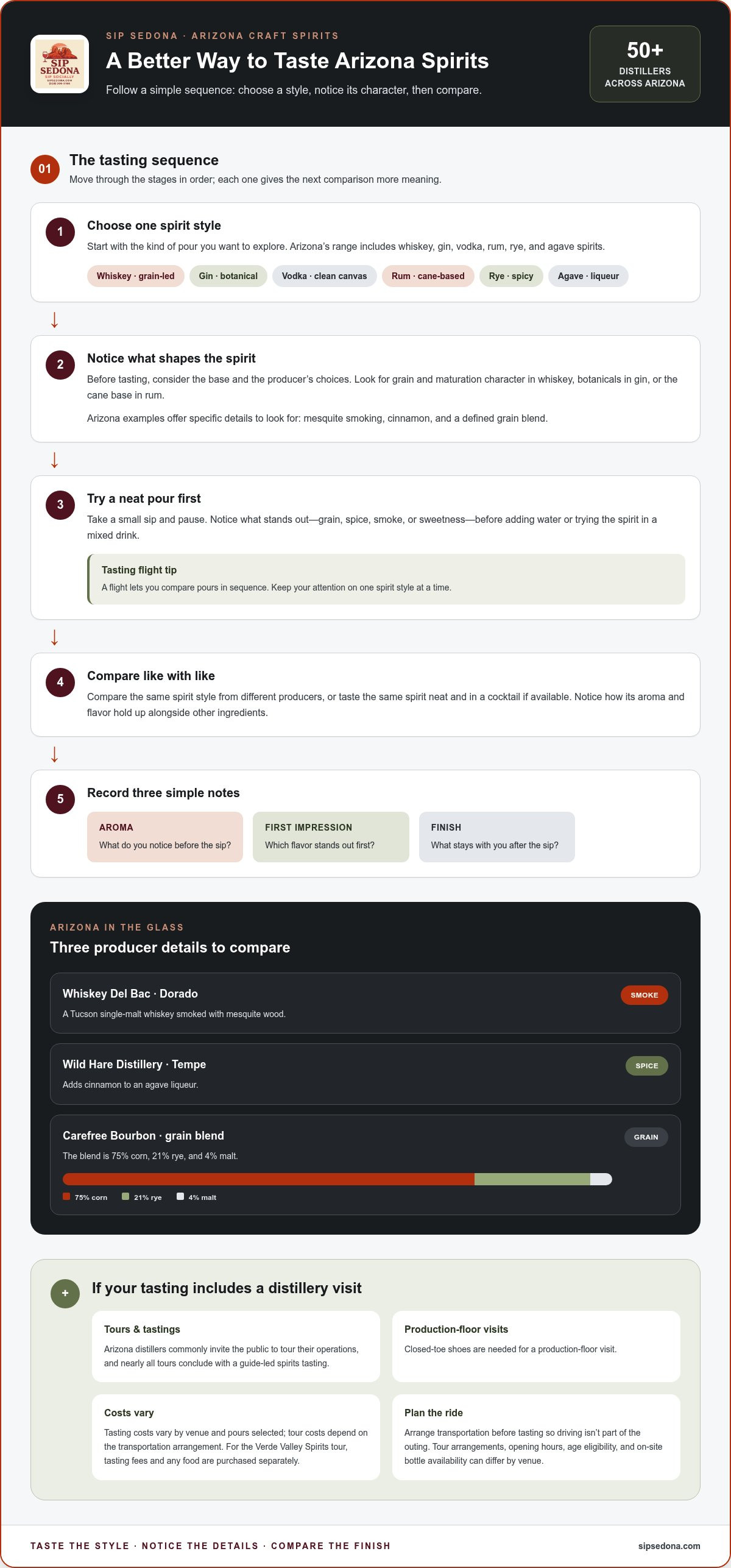
Local character comes through in specific choices. Whiskey Del Bac’s Dorado is a Tucson single-malt whiskey smoked with mesquite wood, bringing a desert ingredient into production. Tempe’s Wild Hare Distillery adds cinnamon to an agave liqueur. These examples show how smoke or spice can shape a spirit’s aroma and finish without masking its base.
Carefree Bourbon offers another detail worth noticing: its blend is 75% corn, 21% rye, and 4% malt. At a restaurant or cocktail bar, scan the menu for Arizona distiller names and ask which local spirit anchors a cocktail. If you’re choosing a neat pour, compare its aroma and finish with the same spirit style from another producer.
Arizona’s craft-distilling history helps explain the range now poured around the state. Arizona Distilling Company became the first distillery to legally produce a spirit in the Phoenix area after Prohibition when it released Copper City Bourbon in 2013. Desert Diamond Distillery, established in Kingman in 2010, is described as Arizona’s oldest craft distillery.
For a focused tasting, choose one spirit category and compare how different producers handle it. Try mesquite-smoked whiskey alongside bourbon, then notice how the smoke, grain, and finish differ. At a tasting room, ask what gives a pour its character, whether that’s a technique such as mesquite smoking or an addition like cinnamon. Those details turn a tasting into a closer look at Arizona craft.
2. Distillery listings by region and amenities
Arizona’s distilleries are spread across distinct landscapes, so location can shape your tasting day. Desert Diamond Distillery is located at the Kingman airport, four miles from Interstate 40. It occupies a two-acre site and operates as a family-run micro-distillery. Elgin Distillery sits 50 miles south of metropolitan Tucson, offering a southern Arizona stop for visitors exploring the region.
What are the best-reviewed Arizona craft distilleries? “Best-reviewed” depends on the review platform and what visitors value, such as guided tastings or production-floor tours. Desert Diamond Distillery and Elgin Distillery are starting points for comparing locations and visitor experiences.
Distillery amenities differ by venue. Arizona distillers commonly invite the public to tour their operations, and nearly all tours conclude with a guide-led spirits tasting. A production-floor visit calls for closed-toe shoes. Ask about tour arrangements, opening hours, and age eligibility as you plan; arrange transportation before tasting so driving isn’t part of the outing.
Can Arizona craft distilleries sell bottles directly to visitors? Bottle sales depend on the distillery and its visitor arrangements, so a tasting-room visit doesn’t necessarily mean every spirit is available to take home. Ask which local bottles or handcrafted spirits are offered on-site.
How much do Arizona distillery tours and tastings cost? For the Verde Valley Spirits tour, distillery tasting fees are purchased separately, and food is purchased separately as desired. Tasting costs vary by venue and the pours selected; tour costs depend on the transportation arrangement.
For celebrations that include a tasting stop, Wedding & Event Transportation can help groups plan the ride as part of the occasion. A clear route between venues makes it easier to enjoy the region’s spirits, scenery, and tasting rooms at an unhurried pace.
3. Arizona-made whiskey, vodka, gin, and rum
Arizona’s craft spirits include whiskey, vodka, gin, and rum, each offering a different tasting experience. Start with the base spirit, then consider its texture, aroma, and finish. Whiskey invites attention to grain and maturation character. Gin brings botanical notes forward, while vodka offers a cleaner canvas for cocktails. Rum has a distinct profile shaped by its cane base.
With whiskey, notice the grain character before adding water or trying it in a mixed drink. Arizona examples show how producers make distinctive choices, from grain blends to smoking techniques. A tasting flight lets you compare pours in sequence. Take a small sip, pause, and note whether grain, spice, smoke, or sweetness stands out most.
Vodka and gin also reward a side-by-side comparison. Both work in cocktails, but gin’s botanical character often makes it more aromatic, while vodka tends to let other ingredients lead. At Phoenix-area restaurants and bars, look for menus that name locally made spirits. Ask which drink highlights the spirit itself rather than burying its character beneath mixers.
Rum offers another style to explore. Compare it neat with a cocktail, noticing its aroma and how its flavor holds up alongside citrus or other ingredients. For an Arizona-made bottle, the ingredient list and tasting notes can help explain the producer’s choices. If a tasting room offers a guided sample, ask about the base ingredients and techniques behind the pour.
Build a useful tasting by focusing on one spirit style at a time. Try a neat pour first, then sample the same spirit in a cocktail if available. Record a few notes: aroma, first impression, and finish. This simple method helps distinguish grain-forward whiskey from botanical gin, or a spirit designed to stand alone from one that shines in a mixed drink. Arizona’s range makes each comparison a practical way to find a style you enjoy.
4. Arizona’s craft distilling history
Arizona’s distilling story has unfolded across the state, from southern vineyards to northern mountain towns. Grand Canyon Brewing began in 2007 and added a distillery in Williams in 2017. Arizona Craft Beverage founded Elgin Distillery in 2014, placing another craft producer south of Tucson.
Other milestones trace the scene’s changing shape. Outlaw Distillery began in 2015 as Adventurous Stills. The Tempe distillery reopened in August 2024 after a fire, then Utah-based Outlaw Distillery bought it in 2025 and rebranded the distillery and product line. These shifts show how Arizona’s craft spirits history includes both new beginnings and changing ownership.
What are Arizona’s craft distillery license rules and production limits? A Series 18 craft distillery must certify that total annual production does not exceed 20,000 gallons per calendar year. Applicants need the necessary federal permits from the Alcohol and Tobacco Tax and Trade Bureau, and licensees must submit annual production reports to the Department of Liquor Licenses & Control.
The Series 18 application fee is $100; issuance costs $450 for a half year or $600 for a full year. Renewal costs $370, with a late renewal fee of $150 in addition to the renewal fee. Under specified circumstances, licensees may also hold one Series 6 or Series 12 license on or adjacent to the licensed premises. A Series 13 Farm Winery license may also be held on the same parcel.
Those rules sit alongside a varied history of local bottles, bourbon, and winery connections. Grand Canyon Brewing’s expansion from brewing into distilling offers one clear example of how an established Arizona beverage business added spirits to its work. Elgin Distillery’s founding in 2014 adds a separate milestone to the state’s developing craft scene.
Planning a group celebration around Arizona spirits? Arrange transportation for your event and enjoy the occasion without making driving part of the plan.
SIP Sedona: The SIP Tour
SIP Sedona offers a relaxed way to explore craft beverages around the Phoenix metropolitan area. Choose the Private SIP Tour for a more personal outing, or the Custom Group Shuttle when your group needs transportation between stops. Wedding & Event Transportation can help organize travel for a celebration, leaving guests free to focus on the occasion.
These options suit visitors who want to pair Arizona tasting rooms with scenic drives and time together, without making driving the focus. For a group outing, share your plans with SIP Sedona and choose transportation that complements the day’s itinerary as you explore the Valley of the Sun.
Contact SIP Sedona to discuss your outing.
Make Your Next Sip a Local Discovery
Let this Arizona craft distillery guide be a starting point, not a fixed itinerary. Pick a spirit style that intrigues you, then leave room for an unexpected favorite. Use the Arizona craft distillery guide as inspiration, not a checklist. A memorable tasting can come from slowing down, noticing what you enjoy, and sharing the experience with good company. The high desert has its own easy rhythm, so leave space for it in your plans.
For a Sedona-area outing, think beyond the pour. Consider how you’d like the day to feel, whether that means a relaxed escape with friends or a gathering focused on the occasion. Let this Arizona craft distillery guide spark ideas for a thoughtfully planned visit, with transportation built into the day.
Start planning your Sedona visit, and enjoy discovering Arizona’s craft spirits at your own pace.
Frequently Asked Questions
What craft distilleries are in Arizona, and where are they located?
Arizona examples include Arizona Distilling Company in the Phoenix area, Wild Hare Distillery in Tempe, and Whiskey Del Bac in Tucson. Carefree Spirits Distillery is in Carefree, while Elgin Distillery is south of Tucson. Grand Canyon Brewing’s distillery is in Williams, and Desert Diamond Distillery is in Kingman. These locations are useful starting points for comparing Arizona’s geographically spread-out spirits scene.
Which Arizona craft distilleries offer tours, tastings, or cocktail bars?
Arizona distilleries commonly welcome visitors for production tours, and nearly all tours end with a guide-led tasting. For a visit, look for an experience that pairs a tour with a sample, then explore nearby restaurants or bars for cocktails made with local spirits. The specific venues and amenities vary by location, so plan around the distillery experience that interests you most.
What spirits are Arizona distilleries best known for?
Arizona producers make a varied mix of whiskey, bourbon, gin, vodka, rum, rye, and agave spirits. For a distinctive example, Tucson’s Whiskey Del Bac makes Dorado, a single-malt whiskey smoked with mesquite wood. Tempe’s Wild Hare adds cinnamon to an agave liqueur. These pours show how regional ingredients and production choices create memorable differences within familiar spirit styles.
What are the best Arizona distillery routes for a day trip or weekend?
For a day trip, focus on one area rather than crossing the state between tastings. A Phoenix-area itinerary could include Tempe and Carefree; a southern route could pair Tucson with Elgin. For a longer trip, plan separate days around northern stops such as Williams and Kingman. Choose a designated driver or arrange transportation before tasting, and leave time to enjoy each stop.
Which Arizona distilleries are near Phoenix, Tucson, Flagstaff, and Sedona?
Near Phoenix, explore Arizona Distilling Company in the Phoenix area and Tempe’s Wild Hare Distillery. Tucson has Whiskey Del Bac, while Elgin Distillery lies south of metropolitan Tucson. Williams offers Grand Canyon Brewing’s distillery for a northern Arizona stop. For a Sedona-area itinerary, the Verde Valley Spirits tour is a regional option. Match stops to your route and transportation plans.
What are the best-reviewed Arizona craft distilleries?
“Best-reviewed” depends on the review platform and what visitors value, such as guided tastings or production-floor tours. Desert Diamond Distillery and Elgin Distillery are starting points for comparing locations and visitor experiences.


