

Arizona’s white-wine story has a high-desert center of gravity: the Verde Valley AVA. Among the best white wines from Arizona are expressive Malvasia Bianca, Viognier, and Chenin Blanc, while the Verde Valley’s vineyards sit around 3,200 to 3,700 feet. Designated in 2021, the AVA gives the region a distinct setting for growing and making wine.
A great white wine is about more than the grape. Elevation, warm days, cooler nights, and vineyard conditions all shape what ends up in the glass. This guide to the best white wines from Arizona covers the varieties grown in the state, what makes the Verde Valley AVA distinctive, and how Arizona’s high-desert climate influences wine. Use it to find a bright, aromatic, or crisp pour that suits your taste.
Key Takeaways
- Explore how the Verde Valley’s high-desert setting gives its wines a distinct sense of place.
- Compare aromatic Malvasia Bianca and Viognier with crisp Vermentino and Chenin Blanc to find styles that suit your palate.
- See how elevation, warm days, and cooler nights shape grape growing and the character of Arizona whites.
- Use winery recognition as a starting point, then consider grape variety and regional character when choosing a pour.
Verde Valley AVA
The Verde Valley AVA gives Arizona wine country a distinct home in the state’s north-central high desert. Designated in 2021, it sits roughly 100 miles north of Phoenix, around a two-hour drive. That places the valley within reach of visitors traveling from the Phoenix metro area, where desert city life and nearby wine culture often meet. An American Viticultural Area, or AVA, identifies a grape-growing region with geographic features that distinguish it from surrounding areas. Its national designation helps wine drinkers connect a bottle’s origin with the landscape behind it.
Elevation is a defining feature here. Vineyards across the Verde Valley AVA sit around 3,200 to 3,700 feet, where slope, sun exposure, and cooler nighttime air can shape grape development. Those site differences matter to wineries choosing where to plant and when to harvest. A vineyard on a warmer, more exposed slope may ripen fruit differently from one with more shade or airflow. The result is a region with varied growing conditions, not one uniform valley profile.
For white-wine fans, the Verde Valley is known for aromatic grapes such as Malvasia Bianca, which grows well here. Its floral, citrusy character is a useful reference when comparing local bottles. Look for the grape name on the label, then note whether the aromas seem bright, floral, or fruit-forward. Tasting notes can help connect those impressions to the variety and vineyard site, making the AVA’s sense of place easier to taste.
The Verde Valley also sits within a broader Arizona wine country that includes Willcox, a separate southeastern region known for grape growing. Comparing wines from Willcox and the Verde Valley can reveal how different sites influence aroma, texture, and balance. Local springs and waterways are part of the valley’s landscape, while elevation and vineyard exposure are more direct factors in grape growing. For travelers planning a wine excursion originating from our Phoenix base, the AVA gives wine lovers a concrete lens: taste the grape, ask where it grew, and connect each bottle to its place.
White grape varieties grown in Arizona
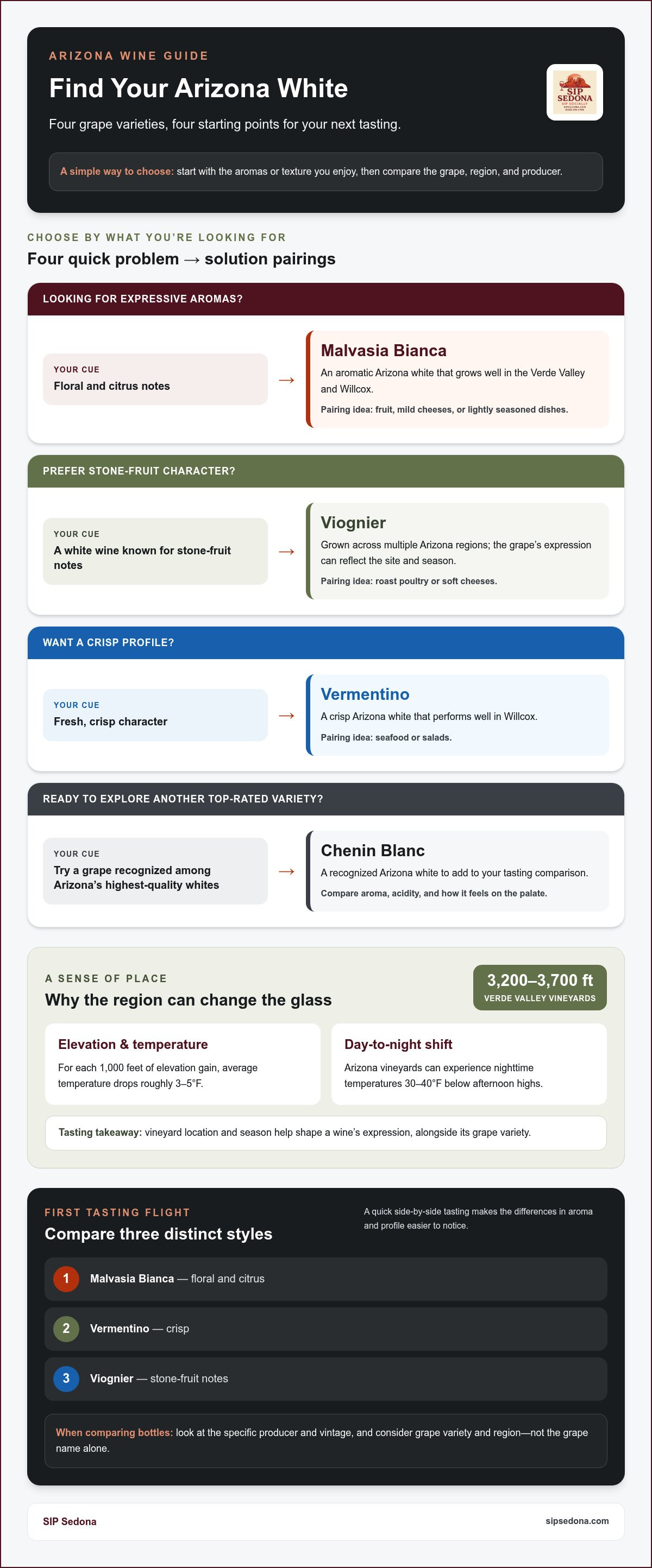
Arizona’s white grapes span distinct styles, from floral and aromatic to crisp and fruit-forward. Malvasia Bianca grows well in the Verde Valley and Willcox, while Vermentino performs well in Willcox. Viognier grows across multiple Arizona regions, and Chenin Blanc is also recognized among the state’s highest-quality whites. Each variety offers a different starting point for a tasting-room visit.
Malvasia Bianca brings floral and citrus notes, making it a natural pick for drinkers who enjoy expressive aromas. Viognier, a French grape variety, is known for stone-fruit notes. Vermentino offers a crisp profile, while Chenin Blanc brings another style to explore. Compare them side by side, paying attention to aroma, acidity, and how each wine feels on the palate.
Which Arizona white wines have the best recent reviews and ratings? Viognier, Malvasia Bianca, and Chenin Blanc are among Arizona’s highest-quality white wines. For a current bottle choice, compare ratings for the specific producer and vintage rather than relying on the grape variety alone.
How do Arizona white wines compare with those from other regions? The state’s range includes aromatic Malvasia Bianca and Viognier alongside crisp Vermentino. The grape, region, and producer all shape the flavor, so comparing the same variety across regions gives you a useful tasting contrast.
What do the best Arizona white wines cost per bottle? Prices vary by producer, vintage, and variety. Production also affects the final price.
Where can you buy Arizona white wines online or in stores? Look for Arizona bottles at winery tasting rooms, local wine retailers, and wineries’ online shops. Search by grape variety or region to narrow your choices.
Which Arizona white wines pair well with common foods? Try crisp Vermentino with seafood or salads, and aromatic Malvasia Bianca with fruit, mild cheeses, or lightly seasoned dishes. Viognier’s stone-fruit character can complement roast poultry or soft cheeses.
For a first tasting, sample Malvasia Bianca, Vermentino, and Viognier together. This simple comparison shows why some of the best white wines from Arizona stand out for their variety, aromas, and regional character.
Arizona terroir and growing conditions
Arizona’s three federally designated American Viticultural Areas are Sonoita, Willcox, and Verde Valley. Their high elevations shape vineyard conditions across the state. Wine-growing regions generally sit around 3,500 to 5,000 feet above sea level, though the Verde Valley ranges around 3,200 to 3,700 feet. Sonoita’s towns sit between 4,500 and 5,200 feet, while Willcox vineyards occupy elevations between 4,000 and 4,500 feet. That variation gives each region a different growing environment.
Elevation helps cool the air: each 1,000 feet of gain reduces average temperature by roughly 3 to 5 degrees Fahrenheit. Arizona vineyards can also experience nighttime temperatures 30 to 40 degrees Fahrenheit below afternoon highs. Those cooler nights influence how grapes develop and help explain why vineyard location matters alongside grape variety. Viognier, for example, is grown in multiple Arizona regions, but its expression can reflect the specific site and season.
Sunshine and rainfall create another balancing act. Arizona receives 12-18 inches of annual rainfall, much of it monsoon-driven; in Sonoita, most arrives from July through September. Summer daytime highs in wine-growing areas at 3,500 to 5,000 feet reach the 90s Fahrenheit. Growers therefore weigh water, heat, elevation, and harvest timing when managing grapes. Willcox produces approximately 74% of Arizona’s wine grapes, making it a major part of the state’s wine landscape.
For tasting, compare an Arizona Viognier with a familiar California white, then notice aroma, texture, and freshness rather than expecting identical profiles. Sauvignon Blanc can offer another reference point for crispness, while Arizona’s Malvasia Bianca brings floral and citrus notes. These comparisons help reveal how place influences a favorite pour. Southern Arizona’s Sonoita and Willcox have distinct elevations and weather patterns, while Verde Valley adds a northern high-desert setting. Spanish explorers recognized southern Arizona’s resemblance to Spain’s soils, an early connection between place and wine. At local wine events, tasting across regions can make those geographic differences easier to experience.
Which Arizona wineries are known for award-winning white wines?
Arizona’s white-wine standouts include Malvasia Bianca, Viognier, and Chenin Blanc, all recognized among the state’s highest-quality whites. A winery’s reputation alone doesn’t tell you whether a particular bottle has won an award. Awards apply to specific wines and vintages, so look for the wine name, vintage, and competition when comparing accolades.
Caduceus offers a concrete Arizona white-wine example: DosLadrones from the 2012 vintage blended 50% Malvasia Bianca and Chardonnay. That blend shows how a winery can combine an aromatic local grape with a familiar variety. It’s a useful reference point when tasting Arizona whites, though the blend itself shouldn’t be mistaken for proof of an award.
For a more rewarding winery visit, start with the grape. Try a Malvasia Bianca for floral and citrus notes or a Viognier for its stone-fruit character. Then compare the current pour with any award-winning vintage listed on the tasting menu. A medal can identify a recognized bottling, but tasting it yourself reveals whether its aroma, freshness, and finish suit your preferences.
In Clarkdale, the Southwest Wine Center tasting room is located at 601 Black Hills Drive. It offers a place to explore Arizona wine and learn about the varieties grown around the Verde Valley. For a broader comparison, look for white wines from different Arizona regions, then note each winery and vintage. Malvasia Bianca grows well in both the Verde Valley and Willcox, while Viognier is grown across multiple regions. Those grapes provide a practical starting point for exploring producers and styles without relying on a single award as a complete ranking.
Planning a wine-country celebration? Explore wine-country event transportation as part of your Arizona outing.
SIP Sedona: The SIP Tour
SIP Sedona’s The SIP Tour offers a relaxed way to explore wine tasting across Sedona and the Verde Valley. After comparing Arizona grapes and regions, put that knowledge to use by tasting local wines in their high-desert setting. The tour is pay-as-you-go, so you choose and pay for the tastings and food you want.
For a private outing, the Private SIP Tour suits a group seeking a more personal experience. A Custom Group Shuttle can help groups travel together, while Wedding & Event Transportation supports celebrations where wine country is part of the occasion. Groups can customize itineraries and flexible pickup times for up to 14 passengers.
Contact SIP Sedona to plan your Arizona wine-country outing.
Let Your Next Tasting Follow Your Curiosity
Finding the best white wines from Arizona can be a personal discovery, not a hunt for one perfect bottle. Let your next tasting answer a question about your palate: Do you prefer lively freshness, generous aroma, or a softer finish? Jot down a few words after each pour. Over time, those notes can guide your choices more clearly than a label or passing recommendation.
Make the experience part of the destination, too. Leave room in your day to take in the landscape, enjoy good company, and discover how a place feels alongside what’s in your glass. Whether you’re planning a relaxed outing or gathering friends for a special occasion, a little intention can turn wine tasting into a memorable Arizona moment. Plan your Sedona wine-country visit and set out with curiosity. Your next favorite pour may be the one you didn’t expect.
Frequently Asked Questions
What are the best white wines made in Arizona?
Start with Malvasia Bianca, Viognier, or Chenin Blanc, all recognized among Arizona’s highest-quality white wines. The right bottle depends on the style you enjoy: Malvasia Bianca is floral and citrusy, while Viognier offers stone-fruit notes. For a gift, choose a variety that matches the recipient’s preferences, then check the producer and vintage on the label.
What are the top Arizona white wine varietals, such as Viognier, Chardonnay, and Sauvignon Blanc?
Viognier, Malvasia Bianca, and Chenin Blanc are strong Arizona white-wine picks. Chardonnay also appears in Arizona winemaking: Caduceus DosLadrones from the 2012 vintage blended Chardonnay with 50% Malvasia Bianca. For a tasting flight, compare those aromatic styles with a crisp white such as Vermentino. The grape name is a helpful guide, but the producer’s notes can clarify each bottle’s particular flavor.
What Arizona wine regions are best for white wine grapes?
The Verde Valley and Willcox are useful regions to explore for Arizona whites. Malvasia Bianca grows well in both, while Vermentino performs well in Willcox. Viognier grows across multiple Arizona regions, giving you a chance to compare how it varies by origin. For a simple tasting, try the same grape from different regions when available and notice differences in aroma and texture.


